


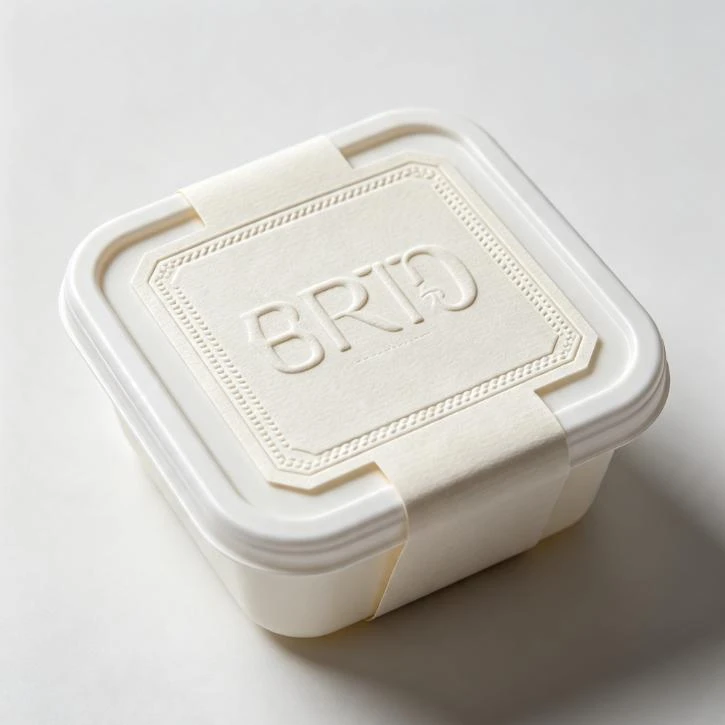
TML Packaging Co., Ltd. is one of the most reliable manufacturers and suppliers of 3d embossing iml in China. If you're going to wholesale bulk 3d embossing iml made in China, welcome to get quotation and free sample from our factory. All customized products are with high quality and low price.
Product Overview
3D Embossing IML is an advanced in-mold labeling technology that combines precise physical texture with high-definition graphics directly during the plastic molding process. By integrating raised or recessed relief patterns into the label structure, 3D Embossing IML provides distinct tactile branding, chemical resistance, and permanent graphic adhesion for rigid plastic packaging.
Key Features of 3D Embossing IML
Tactile Relief Integration
Mechanical and thermoformed processing creates precise 0.1 mm to 0.5 mm relief depth directly on designated graphics.
In-Mold Thermal Bonding
Fuses permanently with container walls during molding, eliminating post-labeling surface defects and delamination.
Precision Print Alignment
Multi-station optical registration ensures exact positional accuracy between printed inks and physical embossed borders.
Hybrid Surface Treatments
Merges matte, high-gloss, metallic, and transparent optical finishes across localized packaging regions.
Material Structure
Face Film: Biaxially Oriented Polypropylene (BOPP) or Polyethylene Terephthalate (PET) engineered for dimensional stability and stretch tolerance.
Printed Layer: High-density UV flexographic or gravure inks formulated for high molding temperatures and mechanical flexure.
Embossing Layer: Controlled structural deformation zone providing sharp physical definition without film perforation.
Bonding Layer: Heat-activated copolymer layer engineered for rapid thermal fusing with target container resins.
Technical Specifications
|
Specification |
Technical Standard / Range |
|
Film Thickness Range |
50 μm - 120 μm |
|
Embossing Relief Depth |
0.10 mm - 0.50 mm |
|
Substrate Compatibility |
Polypropylene (PP), Polyethylene (PE), Polystyrene (PS) |
|
Printing Resolution |
Up to 175 LPI (Gravure / Flexo) |
|
Temperature Resistance |
-20°C to 120°C |
|
Registration Accuracy |
±0.15 mm |
|
Label Supply Formats |
Die-cut single sheets, roll-fed stock, pre-formed shapes |
|
Chemical Resistance |
High resistance to moisture, oils, alcohol, and abrasion |
Design Options
Targeted Brand Relief: Applies custom depth to logos, typography, and symbols to establish distinct brand touchpoints.
Functional Texture Zones: Integrates anti-slip or localized patterned grip areas directly onto specific container handling surfaces.
Optical Finish Contrast: Combines selective matte varnishes with raised glossy details to maximize visual contrast under ambient light.
Applications of 3D Embossing IML
Beverage Packaging:
Enhances rigid cups, bottles, and caps with tactile logos that withstand moisture and cold storage.
Cosmetics Packaging:
Delivers premium dimensional detailing and metallic accents for personal care jars, tubs, and closures.
Household Product Containers:
Provides chemical-resistant, tactile labeling for detergent containers and industrial tubs subject to frequent handling.
Promotional Packaging:
Adds limited-edition visual depth and tactile patterns to specialty food and consumer packaging.
Compatibility Parameters
Successful 3D Embossing IML implementation relies on balancing label physical structure with automated molding conditions. Structural design considerations include:
• Container resin melt flow rate and wall thickness limits
• Injection molding gate locations and cavity pressure dynamics
• Automated robotic label placement speeds and electrostatic charge retention
• Film deformation margins relative to mold curvature angles
Selection Steps
Confirm target resin type, wall thickness tolerance, and molding process parameters.
Define precise vector artwork layers and allowable relief depths to ensure smooth mold release.
Select flat sheet cutouts or roll formats based on robotic placement machine requirements.
Quality Control
Production verification ensures rigorous adhesion standards and dimensional accuracy:
• Cross-hatch adhesion testing of printed and bonding layers
• Optical alignment checks between print registration and physical relief
• Thermal stress testing under simulated injection temperatures
• Micro-caliper depth measurement across production batches
Quotation Requirements
To obtain a precise technical assessment and unit costing, submit the following engineering parameters:
• Label geometry (length × width in millimeters)
• Container CAD drawing or 3D step file
• Container resin material grade
• Molding method (injection molding, blow molding, or thermoforming)
• Vector artwork file with designated embossing callouts
• Required initial order volume and estimated annual consumption
FAQ
Hot Tags: 3d embossing iml, China 3d embossing iml manufacturers, suppliers, factory


